Choosing grinders, screw presses and decanters for coconut extraction lines
Wet coconut extraction is a system decision, not a single-machine purchase. A grinder can unlock surface area, a screw press can recover liquid phase, and a decanter can protect downstream clarification — but the line only performs well when particle size, moisture, temperature, residence time, viscosity, and fiber loading are controlled together.
For coconut processing plants, the equipment choice should be tied to the product target: coconut milk, cream, beverage base, desiccated coconut side streams, or fat-rich extracts for further refining. Each target puts different pressure on uptime, separation efficiency, filtration load, and batch repeatability.
Enzymereach supports processors as an enzyme supplier for coconut processing where enzyme-aided extraction must fit real plant equipment, not lab assumptions. The goal is practical: improve release, manage viscosity, reduce solids stress, and help the line run with fewer surprises.
Start with the extraction objective
Before comparing equipment, define what the extraction section must deliver.
Key questions for the plant team:
- Is the priority higher milk recovery, richer cream phase, lower residual solids, or smoother downstream filtration?
- Will the line process fresh kernel, thawed material, rehydrated coconut, or variable incoming lots?
- Is the bottleneck grinding, pressing, decanter separation, screen blinding, heat exchange, or clean-in-place time?
- Does the plant need a flexible line for multiple recipes, or a narrow operating window for one high-volume product?
- How much variation can downstream standardization absorb before finished-product consistency suffers?
A grinder, press, or decanter that looks efficient in isolation may create load elsewhere. The best selection reduces total line friction.
Grinding: where extraction performance begins
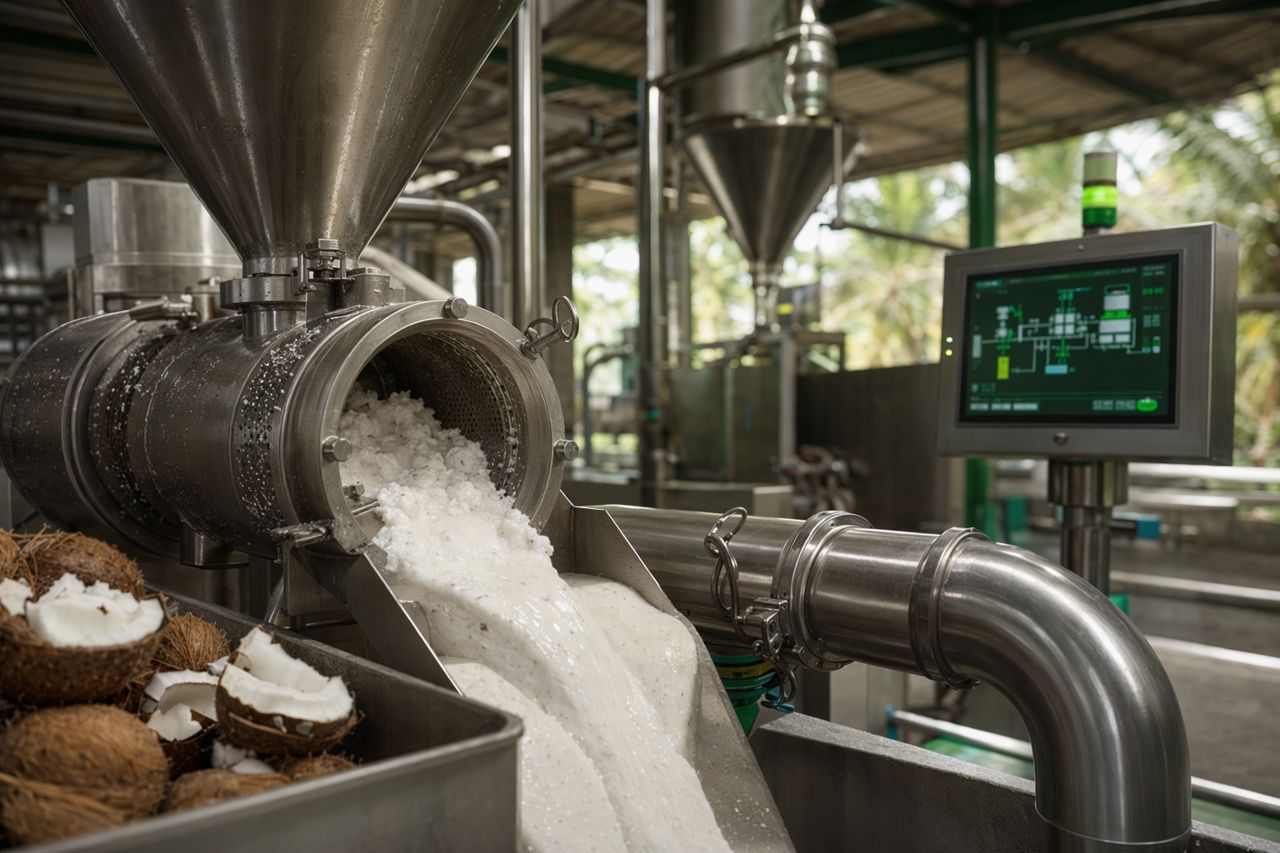
Grinding defines the first major process condition: accessible coconut structure. Too coarse, and liquid remains trapped in fiber. Too fine, and the plant may face high viscosity, emulsified fines, slow separation, and heavier filtration load.
What to evaluate in grinders
- Particle distribution: Consistent reduction is usually more valuable than aggressive size reduction.
- Heat input: Excessive temperature rise can shift product behavior and make viscosity harder to control.
- Moisture compatibility: Fresh and rehydrated coconut behave differently under shear.
- Feeding stability: Surging feed creates unstable extraction and uneven press loading.
- Cleanability: Coconut fat and fiber can build up in dead zones if grinder design is not hygienic and accessible.
Production-minded selection note
For wet extraction, grinder selection should be reviewed together with enzyme contact strategy. If the plant uses enzyme-aided processing, the grind must create enough access for reaction without generating a fines profile that overloads decanters, screens, or polish filters.
Screw presses: pressure, drainage, and cake behavior
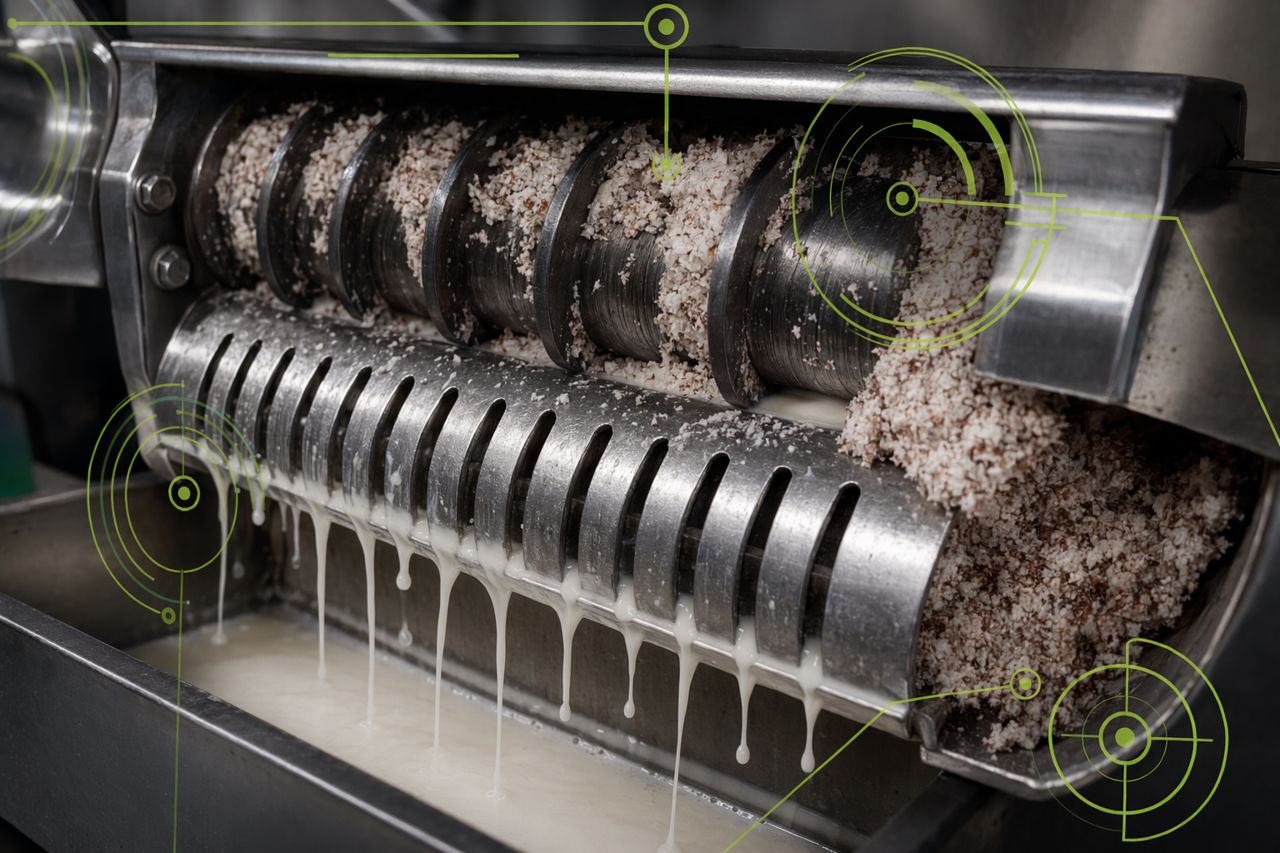
Screw presses are common in coconut extraction because they can provide continuous mechanical recovery from prepared mash. Their performance depends on feed texture, free liquid release, back pressure, screen design, and cake discharge stability.
What to evaluate in screw presses
- Feed consistency: Uneven mash leads to torque variation and unstable discharge.
- Drainage area: Screen geometry affects liquid recovery and solids carryover.
- Compression profile: More pressure is not always better if it drives fine solids into the liquid phase.
- Cake dryness target: Over-drying can reduce throughput and increase mechanical stress.
- Maintenance access: Screens and wear parts should be serviceable without long stoppages.
Where enzymes can change the operating window
In enzyme-supported extraction, the press may see improved liquid release and a different fiber structure. That can be positive for yield and throughput, but the press setup still needs control. The practical target is smoother drainage, lower retained liquid in cake, and stable press loading — not uncontrolled breakdown that makes separation harder.
Decanters: protecting clarification and downstream flow
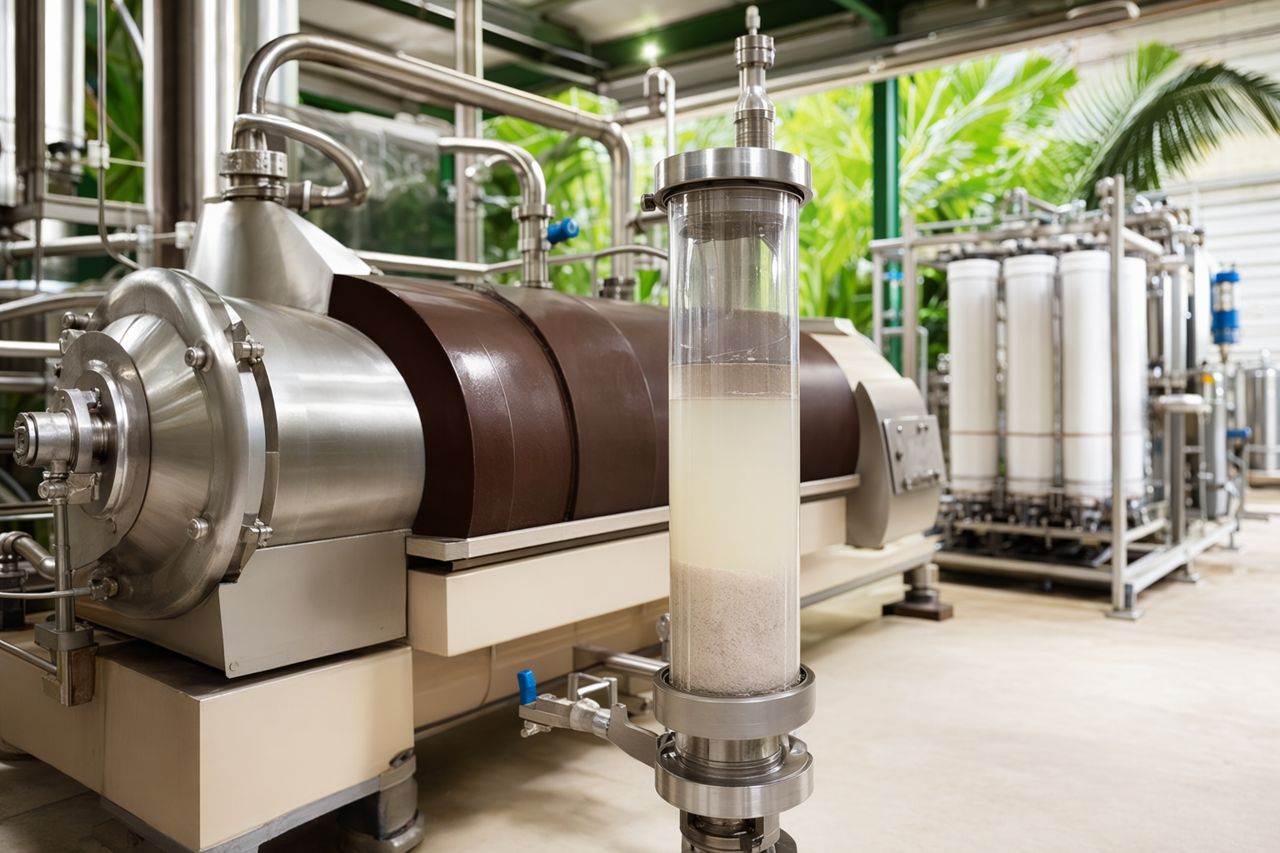
Decanters are often the point where extraction success becomes visible. If grinding and pressing create too many unstable fines, the decanter receives a difficult feed. If upstream treatment supports clean release and manageable viscosity, the decanter can operate with better phase definition and less corrective intervention.
What to evaluate in decanters
- Feed solids profile: Fiber size and fine particle load influence separation stability.
- Viscosity behavior: Thick coconut streams reduce separation efficiency and can increase energy demand.
- Discharge control: Solids handling must match the plant’s waste, feed, or by-product plan.
- CIP design: Coconut fat films require disciplined cleaning access and repeatable wash coverage.
- Control response: Operators need clear signals when feed condition changes.
Decanter selection note
A decanter should not be asked to fix every upstream problem. If the feed is over-sheared, unstable, or highly viscous, the machine may still separate, but at the cost of capacity, clarity, and maintenance. Equipment selection should include realistic feed trials that reflect actual coconut lots and process water conditions.
Matching the equipment train
A balanced coconut extraction line usually comes from matching the three stages rather than maximizing each one separately.
Practical alignment points
- Grinder output should suit press drainage and enzyme contact.
- Press liquid should remain separable, not loaded with unnecessary fines.
- Decanter feed should be consistent enough for stable phase control.
- Heat treatment should support product safety and flow behavior without creating avoidable fouling.
- Tank agitation should prevent settling while avoiding over-shear.
- Filtration should polish, not rescue a poorly controlled extraction step.
Common equipment-selection mistakes
Choosing the most aggressive grinder
Fine grinding can increase access, but it can also increase viscosity and separation burden. The right grind is the one that improves recovery while preserving downstream flow.
Treating the press as the only yield lever
Press performance depends heavily on upstream preparation. If the mash structure is wrong, higher pressure may create more solids carryover rather than better net recovery.
Oversizing decanters without fixing feed quality
More separation capacity does not automatically solve unstable feed. Feed conditioning, viscosity management, and solids profile control can be more valuable than simply increasing machine size.
Ignoring batch-to-batch coconut variation
Kernel maturity, storage, fat content, and moisture all influence extraction. Plants need equipment and process conditions that tolerate variation without constant manual correction.
Where Enzymereach fits into the equipment discussion
Enzymereach does not replace mechanical design. It supports it. For coconut processors evaluating grinders, screw presses, and decanters, enzyme strategy should be considered alongside:
- mash accessibility after grinding;
- liquid release before and during pressing;
- viscosity behavior before separation;
- solids carryover into decanters and filters;
- line stability across coconut lots;
- cleaning burden from fiber and fat residues.
The commercial value is not a technical label on a drum. It is a production result: better recovery, more controlled viscosity, smoother separation, lighter filtration load, and a line that operators can run confidently.
60-second explainer video
[Faceless explainer video embed: coconut extraction equipment selection, showing grinders, presses, decanters, and enzyme-supported flow control with subtitles.]
Buyer checklist for plant trials
Use trials to measure line behavior, not just one outlet sample.
Track:
- feed consistency into the grinder;
- mash texture after grinding;
- press torque stability and cake discharge behavior;
- liquid solids carryover after pressing;
- decanter phase definition;
- filtration pressure trend;
- tank viscosity and pump response;
- cleaning time after production;
- finished-product consistency across batches.
A good trial shows whether the equipment train can maintain performance during normal variation, shift changes, and production-scale residence times.
Request support for your coconut extraction line
If your plant is comparing grinders, screw presses, decanters, or enzyme-supported extraction conditions, Enzymereach can help review the process window and recommend a practical enzyme approach for your target product.
Request a quote through the on-site contact form and share your coconut material, process flow, bottleneck, and product target. We will respond with a production-minded recommendation for your line.